Why Can't Sofas Go in a Skip? POPs Rules Explained (2026)
If you've hired a skip recently, you'll have seen the warning on the booking terms: no sofas, no armchairs, no upholstered seating. It isn't the skip company being awkward, and it isn't a money-grab. Since 1 January 2023, Environment Agency guidance has required all waste upholstered domestic seating to be incinerated rather than sent to landfill, because the foam and fabric in most sofas contain chemicals classed as POPs — persistent organic pollutants. A skip is a mixed load headed for sorting and, ultimately, landfill streams, so one sofa in a skip can legally contaminate the whole container. In this guide we explain what POPs are, exactly which items are caught by the rules, why skips, grab lorries and wheelie bins can't take them, and the simple, compliant way to get rid of a sofa in 2026 — from £90 fixed with our sofa removal service.
What Are POPs — and Why Are They in Your Sofa?
POPs — persistent organic pollutants — are chemicals that don't break down naturally. They persist in the environment for decades, build up in the food chain and are harmful to people and wildlife, which is why they're restricted internationally under the Stockholm Convention and, in Great Britain, under the UK's POPs regulations.
The problem for your living room is a group of brominated flame retardants — most notably decaBDE — that were widely used to fireproof furniture foam and textiles from roughly the late 1980s until they were banned. Testing showed these chemicals turn up in a large share of the UK's waste sofas. Because there's no practical way to test each individual sofa at a tip or transfer station, the Environment Agency's position is blunt: all waste upholstered domestic seating is treated as POPs waste unless you can prove otherwise.
That means it must not be landfilled, and it must not be mixed with other waste that's destined for landfill. The required end point is incineration — in practice, energy-from-waste plants that destroy the chemicals and recover the energy.
What Counts as Upholstered Seating (It's Not Just Sofas)
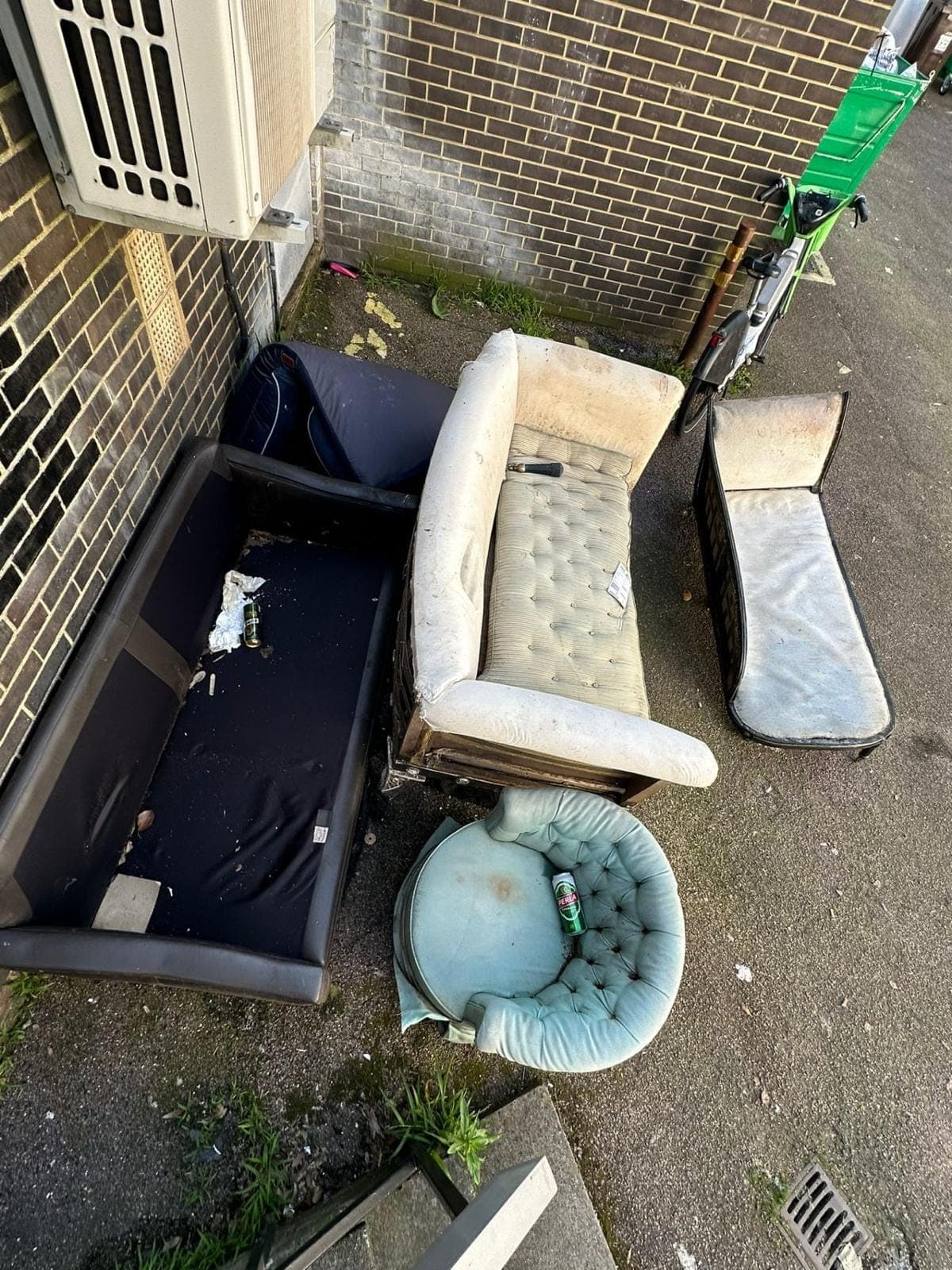
- Sofas, settees and corner suites
- Sofa beds and futons
- Armchairs, recliners and rocking chairs
- Kitchen, dining and office chairs with padded seats, backs or arms
- Bean bags, floor cushions and pouffes
- Sofa cushions on their own — including the loose ones
Leather sofas are included: the leather sits on top of the same foam and textiles. Items are only outside the rules if they contain no upholstery at all (a bare wooden chair, for example), or if they're not seating — mattresses, beds, curtains and blinds have their own disposal routes, but they're not covered by the upholstered-seating requirement.
One important exception: reuse is not waste. A sofa in good condition with its fire-safety label intact can still be donated, sold or given away exactly as before. The POPs rules only bite once you throw it away.
Why Skips, Grabs and Bins Can't Take Them
A skip, a grab lorry load or a commercial bin is a mixed general-waste load. It gets tipped at a transfer station, sorted, and the residual fraction typically goes to landfill. Upholstered seating can't lawfully travel in that stream — and if a sofa is found in a mixed load, the operator may have to treat the whole load as POPs-contaminated, which means separating it out and sending material for incineration at a much higher gate fee.
That cost lands back on you. Most skip and grab operators (including us) now apply found-item charges when prohibited items turn up in a container — typically far more than it would have cost to declare the sofa properly in the first place. The same goes for stuffing a sofa into a communal or commercial wheelie bin: the bin collection is another mixed stream, and your waste remains legally yours until it's handed to a licensed operator who can deal with it correctly.
Cutting the sofa up doesn't help either — POPs waste is POPs waste whether it's in one piece or twenty.
The Compliant Way to Get Rid of a Sofa in 2026
The compliant route is a declared, separate collection by a licensed waste carrier who sends upholstered seating for incineration with energy recovery. Declared is the key word: when we know a sofa is coming, it's kept apart from the general load and consigned to the right facility — exactly what the guidance requires.
At Central Junk we've made that the cheap option rather than the annoying one. Any standard sofa is £90 fixed when you add it as a declared eco item on a man and van rubbish removal booking — we do the lifting from anywhere in the property, you get a digital waste transfer note for your records, and the sofa goes to a licensed energy-from-waste facility. You can check prices for your postcode and book online in a couple of minutes, or see the full price list on our prices page.
Compare that with the alternatives: council bulky-waste collections vary from roughly £30 to £60+ per item depending on the borough, usually with a wait of one to three weeks and a requirement to get the sofa to the kerb yourself. And an undeclared sofa in a skip can cost you a found-item charge on top of the skip price.
Sofa Disposal at a Glance
| Disposal route | Allowed for sofas? | What it costs in 2026 |
|---|---|---|
| Skip, grab lorry or wheelie bin | No — mixed loads can't include POPs seating | Found-item charges if discovered, on top of hire |
| Landfill (any route) | No — banned since 1 January 2023 | Not applicable |
| Council bulky-waste collection | Yes — councils consign seating for incineration | Typically £30–£60+ per item, 1–3 week wait, kerbside only |
| Donation or resale (good condition, fire label intact) | Yes — reuse is not waste | Free, but subject to acceptance |
| Central Junk declared eco collection | Yes — declared, separated and incinerated with energy recovery | £90 fixed for any standard sofa on a man & van booking, with digital waste transfer note |
Sofa Disposal FAQs
Can I put a sofa in a skip if I chop it up first?
No. The POPs rules apply to the material, not the shape. Cut-up sofa pieces in a skip are still upholstered seating waste in a mixed load, and still risk the whole skip being treated as contaminated — with the charge passed back to you.
Can I still donate my old sofa?
Yes. The rules only apply to waste. If your sofa is clean, sound and has its original fire-safety label attached, charities and reuse organisations can take it. Once it's unusable or unsellable, it becomes waste and the incineration requirement kicks in.
What actually happens to my sofa after Central Junk collects it?
It travels as a declared item, separate from landfill-bound waste, to a licensed energy-from-waste facility where it's incinerated and the energy recovered. You receive a digital waste transfer note documenting the whole chain — see our FAQ for more on how our collections work.
Do the POPs rules cover mattresses and divan beds?
No — the requirement is specifically about upholstered seating. Mattresses and beds have their own disposal routes (and many skip firms restrict them for other reasons), but they aren't POPs-controlled items.
Why is the fixed price £90 when some ads promise less?
Because compliant disposal has a real cost: separate handling plus incineration gate fees. Quotes far below that usually mean the sofa is going into a mixed load — or somewhere worse. If a price looks too good to be true, ask to see the carrier's licence and where the sofa will end up.
Related Posts
Fly-Tipping Fines in the UK (2026): What You Risk and How to Dispose Legally

5 Ways To Cut Down On Plastic Waste At Home